+91 9090 0707 82
 info@avanaseniorcare.com

This is one of the hardest decisions you'll ever make, and the world rarely makes it easier. There's an old, unspoken rule that good children keep their parents at home, whatever the cost. So you sit with the doubt, turning it over again and again, wondering whether what you're doing is right, long before you reach the hardest part of all: gently convincing your parents to leave the house they've lived in for thirty, forty, sometimes fifty years.
For an NRI, the weight doubles. You can already hear the neighbours. "Pawar ji ko unke NRI bacchon ne assisted living mein shift kar diya." Mr Pawar's NRI children have put him in an assisted living facility. Said with that particular tilt of the head.But guilt is a poor guide for a decision this important. Look at it plainly instead. Who is with your father at two in the morning if he stumbles? Who does your mother talk to through a long, empty afternoon? Do old friends still climb the stairs to visit, or have those visits quietly stopped already? Once you start asking the honest questions, the choice often looks very different. Here is a practical guide to making the move without breaking anyone's heart, your own included.
Start the conversation long before the move
The smoothest moves begin as a handful of gentle chats, never one big announcement. If your parent feels the decision was handed to them, they'll resist the place on principle. If they feel they had a say in it, they arrive as a participant rather than a parcel. You can lay this groundwork from abroad, over your usual calls, weeks ahead. Mention a community you happened to visit, or share a photo or two of a friend's parents who've settled in somewhere lovely and look genuinely happy. Let the idea grow familiar long before it ever becomes a plan.
Visit together, even if it's only once
If you can line up your next trip with a visit to a community, do it. Let your parent walk through the dining room, meet a member of staff, sit for a while in a room that could become theirs. A place stops being frightening the moment it turns familiar. And if you truly can't be there in person, ask the community for a video walkthrough and a call with the team, so your parent meets a warm face before the day arrives. Pass on their likes and dislikes beforehand too, so the staff can make that first visit feel thoughtful rather than generic.
Use a trial stay to take the pressure off
Nothing softens fear like the word temporary. A trial stay lets your parent treat the move as an experiment rather than a life sentence. The flat stays as it is, the options stay open, and they simply get to see how the place feels. So much of the anxiety in these moves comes from the sense that there's no going back. Take that away, and shoulders drop on both sides.
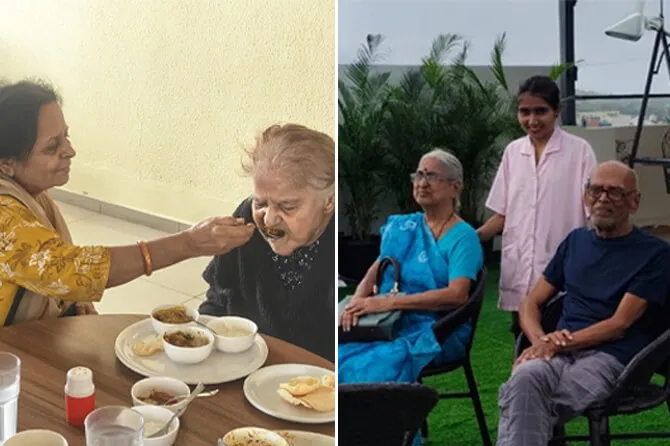
Go for a slightly longer trial if you can. Our parents need a little time to lower their guard with the other residents, but once they do, the friendships come easily. Say what you like about that generation, they are masters at making friends, far better at it than most of us, and miles ahead of the Gen Z who can share a room and never once look up from their phones.
Make the new room feel like theirs
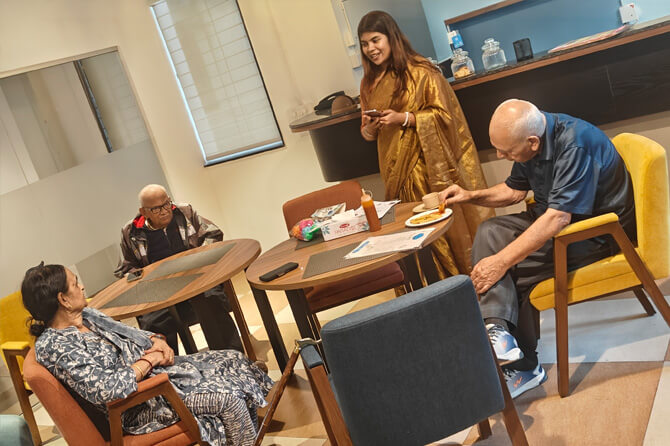
A familiar quilt. A few framed photographs. The radio they've fiddled with for years. The little shrine they pray at each morning. These things do far more than decorate a room. They tell an unsettled mind that this is home, not a hospital ward. Send them ahead, or ask a sibling or a trusted relative to carry them down, so the room is personal and waiting from the very first night.
Plan the first week, then loosen your grip
Make yourself especially reachable in that first week, by call or video. Then, oddly enough, ease off a little. A barrage of "are you okay, are you sure you're okay" tends to feed anxiety rather than settle it. Try gentler questions instead. How was your day? What did you get up to? How's the chap in the next room? Those will tell you far more about how your parent is actually feeling. Let them start building a routine and a few friendships of their own. The aim is for them to belong there, not to lean entirely on your voice down a phone line.
Lean on the care team as your eyes and ears
This is where the distance becomes bearable. A good community keeps you in the loop, flags anything that worries them, and sets up video calls so you can see your parent's face and read it for yourself. Ask for that rhythm to be agreed from day one. The moment you trust that someone capable is watching closely on the ground, those eight thousand miles begin to shrink.
Give it time, and forgive the rough days
The first fortnight is rarely smooth. Your parent might go quiet, or turn cross, or insist they want to go home. That's grief for a familiar life, not proof that you've failed them. Settling in usually takes a few weeks, sometimes a little longer, and the turn tends to come quietly: a new friend at the lunch table, an activity they've started to look forward to, a morning they simply wake up content. Watch for those signs, rather than fixing on the hard early days.
A word about your guilt
A great deal of the strain in these transitions isn't your parent's at all. It's yours. The guilt of living far away, of not doing the caring with your own hands, of choosing a community over your own spare room. Hold it gently, and then set it down. Choosing a place where your parent is safe, busy, and looked after around the clock is not abandonment. It is one of the most responsible kinds of love there is.
How Avana approaches the move
At Avana Cares in Kiwale (Ravet), Pune, we treat the move as the most delicate part of the whole journey, never an afterthought.
Our 90-Day Trial Stay gives your parent room to settle down, our team keeps families abroad updated, and we help make each room personal before arrival so it feels like home from the very first night. If a move is on your mind and you want to do it kindly, talk to us on +91 9090 0707 82.