+91 9090 0707 82
 info@avanaseniorcare.com

Initially when most of NOK’s book consultation for an assisted living facility, they don’t feel good about it. Honestly, they should, but surprisingly they don’t feel quite comfortable with the thought. For most it’s like the last resort after trying everything else first, the daily calls, the hired help, the sibling rotations, the long flights home and this is what is left. The decision that was always sitting at the end of the road, waiting, waiting and waiting till it becomes unavoidable, but why?
We Inherited a Standard Built for a Different Life
There was a time not so long ago when the architecture of Indian family life simply absorbed ageing. Grandparents lived inside the household. Care was distributed without being discussed, because it was just what happened. A daughter-in-law managed medications. A son drove to appointments. The neighbourhood knew your parents by name.
That world required certain conditions to function: people living in the same city, often the same building. Women structurally available to provide daily care. Extended families close enough to share the load.
Most urban and NRI families today have none of those conditions. Careers moved people. Apartments replaced ancestral homes. The son is in Hyderabad, the daughter is in Dubai, and the parents are in a city where the familiarity of the neighbourhood is slowly becoming the only constant they have.
The structure changed. The expectation did not, and that is exactly where we forgot to evolve.
So when an adult child considers assisted living, they are not just making a practical decision. They are stepping outside a script they were handed at birth, and the discomfort of that, the social exposure of it, gets called guilt.
It is worth asking whether that guilt is actually telling you something useful, or just telling you that the script is old.
The Question Underneath the Guilt
Most families circling this decision are privately asking: What will this say about us?
It is worth replacing that with a harder question: What does my parent's day actually look like right now?
Not the version that gets described on Sunday calls. The real one. How many hours pass without a conversation that goes anywhere? Is there a routine that gives shape to the day, or does each morning drift into afternoon without much to separate them? Are they eating properly? Sleeping through the night? Do they have anything to look forward to that does not depend on when you visit next?
These are the real questions you should be asking them and yourself before making a decision. They are the actual measure of whether someone is living well or just surviving.
Early signs of cognitive decline often show up in exactly these small, domestic ways, a recipe your mother once knew by heart, now missing a step. An appointment forgotten. A repeated question that did not use to repeat. Families notice these things intuitively, often before they have language for what they are seeing.
And families often wait, because acting on what they are seeing means having a conversation nobody is ready for. Roughly 11% of Indians are now aged 60 and above, and among them, around 7.4%, nearly 8.8 million people, are living with dementia, with India's senior population set to cross 180 million by 2030. The care infrastructure needed to support that scale does not yet exist in most Indian homes. And waiting, in many cases, costs the parent months or years of a better arrangement.
What Actually Happens Inside a Good Facility
The image many families carry of assisted living is an old one, trust me. Institutional corridors. Rotating strangers. A parent sitting in a chair, watching time pass, is not what we do and was never the goal.
That picture is worth updating in your mind, so close your eyes and imagine what Avana Cares describes in its approach to assisted living:
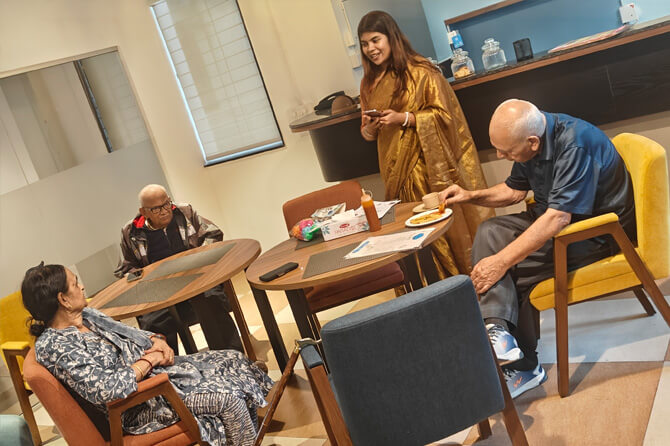
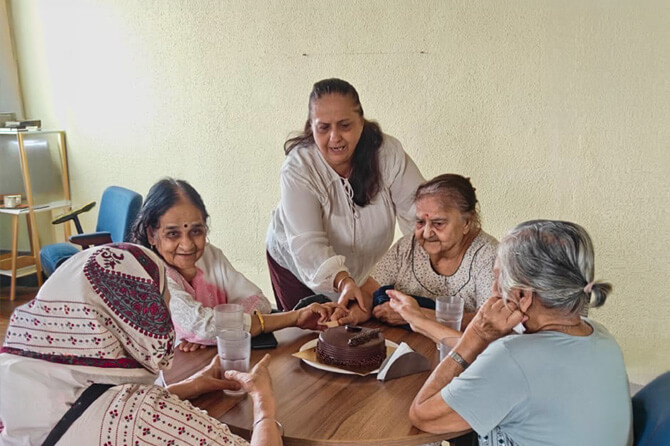
A designed day, unlikely not dumped with clinical scheduling, but intentionality and peace wrapped to our every resident. Music sessions that surface memories that conversation no longer reaches. Art that gives form to feelings that have lost their words. Meals that happen on time, with company, with something to talk about. Outings. Birthdays celebrated with the people you now see every day.
The small wins that come out of this:
Today. I painted something, and we went to the temple. That kirtan last week was wonderful.
and is not small at all. For a parent whose world has been gradually narrowing, they are what makes a day feel worth having.
This is what Mr. Sameer and Ms. Nihharikaa Nagrani built Avana Cares around the understanding that care is not just the management of decline, but the active preservation of a life worth living. Their approach and founding philosophy are worth reading before you evaluate any facility, because it tells you what the people running it actually believe care means.
The Person Nobody Mentions
Apart from our beloved parents, there is someone else in this conversation who tends to go unnamed.
The family member who is currently carrying the primary load. The daughter who rearranged her work life around her mother's schedule. The son who sleeps lightly because he has learned that 2 AM phone calls happen. The spouse who has not had a week to themselves in years.
Our conversations with caregiver experience describe this honestly: love becomes the language of home care, but exhaustion becomes its constant companion. The watching, the reminding, the invisible mental load of tracking medications and moods and what happened yesterday wears people down in ways that only become visible when something breaks.
And when a caregiver breaks, and when we say this we know many do, quietly, without announcement, the parent loses the one person who knows their rhythms best.
Choosing assisted living is not choosing against your parents. In many cases it is the only decision that actually protects them because it takes the sustainability of their care out of the hands of one exhausted person and puts it into the hands of a trained, rested team.
If you are currently the person holding this weight, Avana's piece on transitioning parents to assisted living without stress addresses what that shift actually looks like in practice.
For Families Managing This from Abroad
The distance gives everything a particular texture.
Families searching for one sometimes land on the other simply because the marketing language overlaps. Ask directly: is this facility structured around medical dependency, or around helping someone live well while ageing? The honest answer to that question should decide a lot.
You are making decisions based on phone calls that your parents shaped carefully, because they did not want you to worry. The visits are short and compressed; you see a version of their life, not the full one. And in the weeks after you leave, you are working with whatever picture you managed to put together in four days.
Assisted living, especially facilities as an entry point, gives you something that distance otherwise makes impossible: continuity. Someone is present every day. The care does not reset every time a flight schedule allows it.
For NRI families evaluating options without the ability to visit repeatedly, Avana's list of questions to ask before choosing a facility is a practical starting point that cuts past surface-level presentation and asks about the things that actually determine daily quality of life.
On Timing
There is a version of this decision that gets made in a crisis when a fall happens, when a diagnosis accelerates, when the home situation becomes unsafe overnight. That version is harder for everyone, including the parent, who is adjusting to a new environment at the same moment they are managing an acute situation.
Earlier is almost always better. A planned transition, where a parent has time to settle, find a rhythm, recognise faces, feel at home, is a fundamentally different experience.
Some signs that this conversation should happen now rather than later:
- Days passing with limited real social contact at home
- Cognitive or physical changes that are progressing, not stabilising
- Safety concerns the current home setup cannot adequately address
- A primary caregiver whose own health is visibly deteriorating
- A parent who has expressed loneliness or purposelessness and for whom there is no realistic solution at home
None of these alone is a verdict. Together, they are a signal worth taking seriously before circumstances make the decision for you.
Frequently Asked Questions
Why do Indian families feel guilty about assisted living?
The guilt comes from a generational script built around joint families and in-home care, a structure most urban and NRI families no longer live inside. The expectation stayed fixed even as the conditions that made it possible disappeared. That mismatch, not a failure of love, is what guilt is usually pointing to.
Is assisted living in Pune a good option for parents with dementia or Alzheimer's?
For parents with progressing cognitive decline, a facility with dedicated memory care, structured routines, trained staff, therapeutic activities, and a safe environment typically offers more than an untrained family can sustain alone over time. Facilities in Pune like Avana Cares are specifically designed for this.
How do I know when it is time to consider a care facility?
Key indicators include increasing isolation, progressing cognitive or physical decline, safety concerns at home, and unsustainable caregiver strain within the family. Avana Cares' 10-question guide is a useful tool for making this assessment more concrete.
What is respite care and is it a good starting point?
Respite care is a short-term stay anywhere from a few days to a few weeks that allows families to evaluate a facility while giving the primary caregiver temporary relief. For families who are uncertain, it is often a lower-pressure entry point than a permanent placement decision.
Can NRI families manage this from abroad?
Yes. Many facilities support remote families through virtual consultations and short-term stay options before a permanent decision is made. Getting in touch with Avana Cares directly is the most efficient way to understand what that process looks like.
Does choosing assisted living mean the family becomes less involved? Not typically. It changes the nature of involvement from daily logistical management to more present, quality time during visits. Many families find that the relationship with their parent actually improves once the practical pressure of full-time caregiving is removed.
The guilt is not going to disappear the moment you make a decision. That is not how it works.
But guilt is not the same as a verdict. It is an emotion shaped by a story you grew up inside, and stories can be examined, updated, held differently.
The actual question is simpler than the guilt makes it feel: will my parent have a better day, more days, with more in them?
If the answer is yes, that is enough to go on.
Talk to the team at Avana Cares. Not to be sold something, to understand what the options actually look like.