+91 9090 0707 82
 info@avanaseniorcare.com

Mr Kulkarni is 81 years old, lives in a quiet society in Pune, and by every account is doing just fine. That, at least, is what he tells his daughter Anjali every Sunday from her kitchen in Chicago, where it is still early morning. He asks after the grandchildren. He grumbles cheerfully about the cricket. He says the knee is the same as ever. Ten warm minutes, the call ends, and Anjali goes about her week reassured.
It would be another year before the family understood that the signs had been there all along, scattered across those Sunday calls and the silent stretches between them, each one small enough to explain away.
This is how dementia usually arrives in our families. Not with a single dramatic moment, but with a slow drift that everyone notices a little and nobody quite names. And here is the part worth holding on to before we go any further: catching that drift early is genuinely good news. The sooner a family understands what is happening, the longer a parent can keep living well, with the right support around them. So let us walk through Mr Kulkarni's year, because his story carries nearly every sign worth knowing.
The same story, twice in one call
The first thing Anjali noticed, though she thought nothing of it then, was the repeating. Her father told her about the building's new watchman, the whole tale, twice in the same call, almost word for word, with no sense that he had just said it. Everyone repeats a good story. What was different was that he had no memory of telling it at all, only minutes earlier. Ordinary forgetfulness loses the name of an actor. This was losing the conversation itself.
The spectacles in the fridge
Then things began turning up in odd places. His spectacles in the refrigerator. The television remote tucked inside a shoe. Because he could not retrace his own steps, he decided someone must be moving his things, and the maid was quietly let go under a cloud of suspicion she did not deserve. The misplacing is common enough with age. The leap to "someone is stealing from me" is the part a family should notice.
The bill he could not solve
Mr Kulkarni had run the household accounts for fifty years, down to the last rupee. So when the society secretary mentioned, almost in passing, that he had paid the electricity bill twice over and then forgotten the maintenance altogether, Anjali felt the first real flicker of worry. A man who once balanced everything in his head was suddenly lost in a simple bill.
The empty chair at the temple
The bigger changes, oddly, were the quiet ones. He stopped going to the temple he had visited every single morning for decades. He dropped out of the evening card game in the society garden. The harmonium he loved sat untouched in the corner. The family read all of this as a low mood, perhaps a touch of loneliness. In truth, withdrawal and loss of interest are among the earliest and most overlooked signs of all, precisely because they look like sadness rather than illness.
The afternoon he could not find his way home
One afternoon he set off for the chemist two lanes away, a walk he had made a thousand times, and a neighbour found him forty minutes later at the wrong gate, unsure which building was his. He laughed it off. The neighbour mentioned it to his son, who mentioned it to Anjali. Getting lost in a deeply familiar place, or losing track of the day, the month, the season, is one of the clearest signals that something has shifted.
A gentle man, turning sharp
The father Anjali grew up with had been patient to a fault. Now he snapped easily, grew suspicious of old friends, and seemed anxious in a way he never used to be. In the middle of a sentence he would stall, reaching for an everyday word and landing on "that thing, you know, that thing" instead. Families almost always read these as emotional, just a difficult phase, when they can be the brain itself beginning to struggle.
The things he would never have let slide
And slowly, the small dignities slipped. The crisply ironed shirts gave way to the same clothes worn three days running. The famously tidy flat grew cluttered. Meals were skipped, not for any lack of food, but because he simply forgot to eat. For a man who had always taken quiet pride in his appearance and his home, this was the loudest sign of all, and the hardest to watch.
Why the Sunday call hid all of it
Through every one of those months, the Sunday calls stayed cheerful. This is the cruel little trick of early dementia. People become remarkably good at masking, and they save their very best masking for the children they most want to reassure. Your ten-minute call is a performance, however loving it is. The truth tends to live in the gaps: in what an aunt mentions after a wedding, what a neighbour says about a wander down the road, what the watchman has quietly started keeping an eye on. Listen to those voices as closely as you listen to your parent's own.
What to do if any of this sounds familiar
Don't try to diagnose down a phone line, and don't panic. None of these signs on its own means dementia. Everyone misplaces their glasses and forgets a name now and then. What matters is the pattern, and a clear change from the parent you have always known.
The right next step is a proper assessment by a geriatric. Ask a trusted relative to take your parent, or arrange it for your next trip home. An early, honest picture lets the whole family plan calmly, rather than scramble after a crisis has already hit.
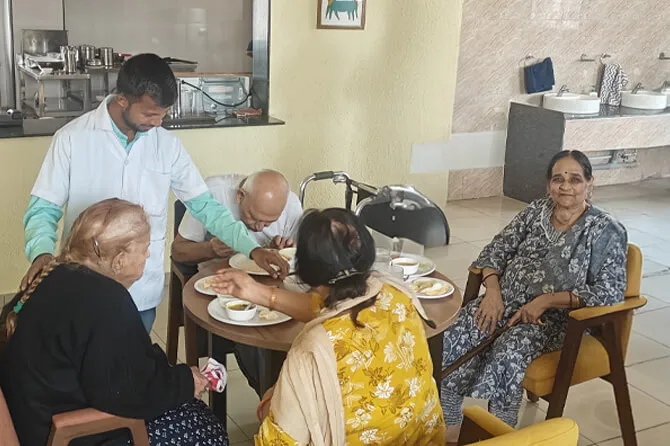
It also helps to think a little ahead. A parent in the early stages can live well for years with the right structure around them: a steady daily routine, real social contact, activities that keep the mind working, and people close by who will catch the next small change quickly. That is precisely what good memory care in Pune is built to provide, long before anything reaches a crisis point.
You are not failing them by noticing
If you have read this far with a knot in your stomach, recognising your own parent in a line or two, please be gentle with yourself. Noticing is not betrayal. It's an act of care. The families who come through this best are not the ones who somehow saw it all coming from across an ocean. They are simply the ones who looked clearly, and acted a little earlier than they would have liked to.
Mr Kulkarni, for what it is worth, is doing far better now than he was in that frightening year. Diagnosed, supported, and held in a routine with company around him, he tells his old stories again, sometimes twice, and the family has learned to simply enjoy the second telling.
At Avana Cares in Kiwale (Ravet), Pune, our approach to dementia and memory care begins where it should, with patience and dignity, never fear. If you are seeing changes in a parent and aren't sure what they mean, we are glad to talk it through. Reach us on +91 9090 0707 82.