+91 9090 0707 82
 info@avanaseniorcare.com

It is the question that keeps you awake at the wrong hour in another time zone. Your parent has been diagnosed with dementia, or you strongly suspect it, and you are trying to work out whether they are safer at home with help, or in a facility built for memory care. For some families there is real nuance here. But if you live abroad and cannot be there month on month, the honest answer is clearer, and arrives sooner, than most people expect. Let us walk through why.
What safety really means in dementia
Start with what we are actually trying to protect. Safety in dementia is not just about preventing a fall. It is medication taken correctly and on time. Meals actually eaten. The gas not left burning. The front door not opened to a stranger at midnight. Wandering handled gently rather than with a bolted gate. And underneath all of it, a parent who feels settled and accompanied, not frightened and alone. A home can be spotless and step-free and still fail every one of these quieter tests. Hold that fuller idea of safety in mind as you weigh the two paths.
The pull of home, and why it loosens when you live abroad
There's a genuine argument for home, and it would be dishonest to skip past it. Familiarity protects an ageing mind. A parent who knows every corner of the flat, every neighbour, every turn on the walk to the temple, stays oriented for longer than one moved somewhere new. Routine and surroundings work like scaffolding for a fading memory.
But that argument leans on something most NRI families simply cannot supply: presence. Good home care for dementia is not one kind maid. It is a reliable, trained attendant by day, another awake and alert through the night, a nurse on call, and, most importantly, someone responsible standing over all of it. Checking the medicines were actually given. Noticing the new bruise. Replacing the carer who didn't turn up this morning. From eight thousand miles and a twelve-hour time difference away, you cannot be that someone. You end up managing a fragile chain of people you've never properly met, over calls placed at 3 am your time. Home care looks affordable and manageable on a spreadsheet, and then quietly frays under the strain of nights, sick days, and staff who leave without notice.
Loneliness is not just sad, it is a risk
Here's the part families rarely weigh, and it may matter most of all. Even if you somehow assemble flawless home care, a parent at home with dementia is usually profoundly alone. The friends visit less. The conversation shrinks to instructions from an attendant. The day empties out.
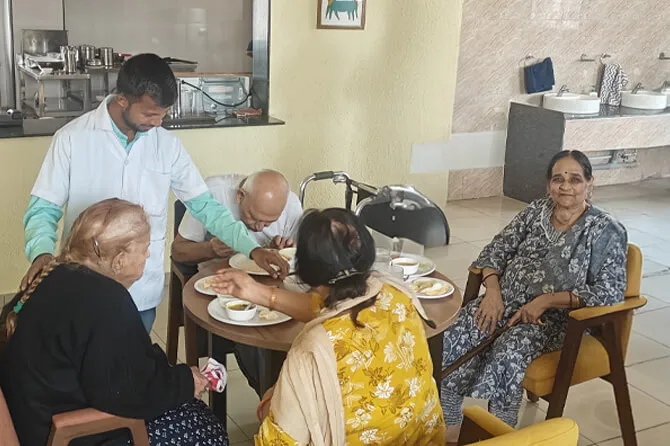
Loneliness is not merely unhappy. Social isolation is now recognised as one of the modifiable risk factors for cognitive decline, which means the very solitude of sitting at home, however well-tended, can push the dementia along faster. A parent in a good community, by contrast, has people at every meal, faces they know, and small reasons to get up and join in. That daily company isn't a frill. It is part of the care itself. And this is the quiet irony of trying to keep a parent at home for their own good: the isolation that comes with it can be one of the worst things for them.
"But ₹80,000 a month for assisted living is expensive"
It sounds it, until you actually add up what good care at home costs. So let us add it up honestly.
What home care really costs each month
- Day caregiver: ₹25,000 to ₹35,000
- Night caregiver: ₹20,000 to ₹30,000
- Visiting nurse, doctor, physiotherapy: ₹10,000 to ₹20,000
- Food and groceries: ₹8,000 to ₹15,000
- House help: ₹5,000 to ₹8,000
- Medicines and equipment: ₹8,000 to ₹15,000
- Electricity and utilities: ₹4,000 to ₹8,000
Total: roughly ₹80,000 to ₹1,30,000 and upward.
And even after spending all of that, you still have no genuine round-the-clock supervision, caregivers who fall ill or simply don't show up, a parent with little or no social life, and a family living in a constant low hum of worry.
What around ₹80,000 covers at a memory care community
- Trained care, twenty-four hours a day
- Medical and physiotherapy support on site
- All meals, housekeeping and laundry
- Safety systems and a real emergency response
- And the one thing a home cannot bottle: A team, not an individual with proper processes SOP’s and guidelines.
At home, you are managing chaos. Here, you are handed a system. It is not more expensive. It is simply more honest about what proper care actually takes.
For an NRI, the gap only widens, because the single thing that might hold a home setup together, a family member supervising it day after day, is exactly what the time zones make impossible.
So, for a family living abroad, which is safer?
For most NRI families, once dementia is genuinely in the picture, a dedicated memory care facility is the safer choice, and usually the kinder one too. Safety in dementia comes down to constant, trained, waking attention and real human company, and that is precisely what a lone attendant in an empty flat cannot sustain, and what you cannot supervise from another continent.
The wrong question is "how do I keep them home for as long as possible." The better one is "what gives my parent the safest, most dignified, least lonely life at the stage they are actually at." Asked that way, the answer for families abroad tends to point in one direction.
You don't have to decide forever today
Many families begin with a 90 days trial stay, watch how their parent responds to a structured, sociable, supervised setting, and let that experience make the decision for them.
Avana Cares in Kiwale (Ravet), Pune offers assisted living and memory care built around exactly this question, safety and dignity together, with company built in. If you are weighing home against a facility for a parent with dementia and want a straight, honest conversation rather than a sales pitch, talk to us on +91 9090 0707 82.